

June 23, 2026
Trevor Madden '29 learns the math behind magic
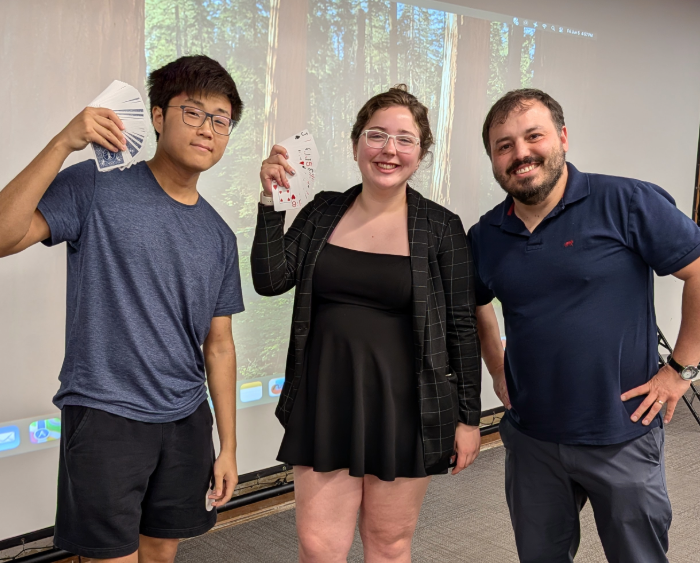 Trevor, Jacsyn, and Enrique Treviño
Trevor Madden '29 spent the first weeks of summer learning magic tricks—and the mathematics behind them—through Ernest H. Volwiler Professor of Mathematics and Chair of Mathematics and Computer Science Enrique Treviño's Richter research project “Magical Mathematics.”
Here's Madden's perspective on the experience:
Magical mathematics
It may not sound like much, but the magic tricks I have learned in this Richter project can make people happy or at least entertained. The card tricks are quite impressive, and even more so to mathematicians. Each day, my fellow Richter Scholar Jacsyn Rose Disrud '29 and I spent two to three hours trying to learn a new trick. We would then discuss how the card trick is performed and why it works.
The card tricks have a lot of math behind them. Some outcomes rely on how the deck is shuffled. For example, the Monge Shuffle, Hummer Shuffle, and Down and Under Shuffle each have a different mathematical proof for the outcome of a trick. These shuffles keep the cards in a specific order or parity. Other tricks unrelated to shuffles rely on a preset deck of cards, memorization, and some vague information from the audience.

Keeping numbers entertaining
This experience has certainly added to how I have thought about my future path. My job as a Certified Public Accountant will not be to just crunch numbers and help people, but be welcoming and whole-hearted. I thought about how people may feel uneasy with their troubles in finances. Although magic tricks may be a small distraction, I overall hope to give people happiness and peace when it comes to financial matters.
I was unsure how I would make people happy with just what I knew, but I had a weird idea that maybe this project and the card tricks I have learned could be one way to do that. I may have expected some general misdirection techniques rather than relying on card tricks and math patterns, but if at any point I have a deck of cards and some faces that need cheering up, I know who to thank for this rare opportunity.
Maybe Richter wasn’t really created ideally for magic tricks, but nonetheless I was determined to learn these tricks with a goal in mind: to not just get through school, but to enjoy the struggle and investment of time in my courses and material.
About the Richter Scholar Summer Research Program
The Richter Scholar Summer Research Program provides students with the opportunity to conduct independent, individual research with Lake Forest College faculty early in their academic careers.
The ultimate goal of this program is to foster a strong commitment to the intellectual life, and to encourage participating students to consider careers in research and teaching.
Academically excellent students with an interest in research are invited to apply for the Richter Scholar Summer Research program in the early spring of their first year. During this time, they work one-on-one with a faculty member, doing independent research in one of a wide variety of fields. As the Richter Scholars live and work together and participate in a weekly colloquium, they become a community of peers, providing encouragement and support for one another’s research endeavors. The result is a group of scholars motivated to continue their intellectual achievement in the future.