

The Richter Scholar Summer Research Program provides students with the opportunity to conduct independent, individual research with Lake Forest College faculty early in their academic careers.
Set yourself apart with research early in your undergraduate career.
Lake Forest College offers a unique opportunity for undergraduate students to gain hands-on research experience across disciplines—sciences, arts, and the humanities—early in their academic careers.
Richter Scholars work closely with a faculty member doing independent research in a wide variety of fields. Students spend four or eight weeks over the summer contributing to and publishing high-level research. Richter projects often grow into long-term research interests that carry throughout undergraduate studies and lead to grad school placements.
2026 Summer Program Dates
Option I (four weeks)
May 12 through June 5
Symposium held on Friday, June 5
Option II (eight weeks)
May 19 through July 10
Symposium held on Friday, July 10
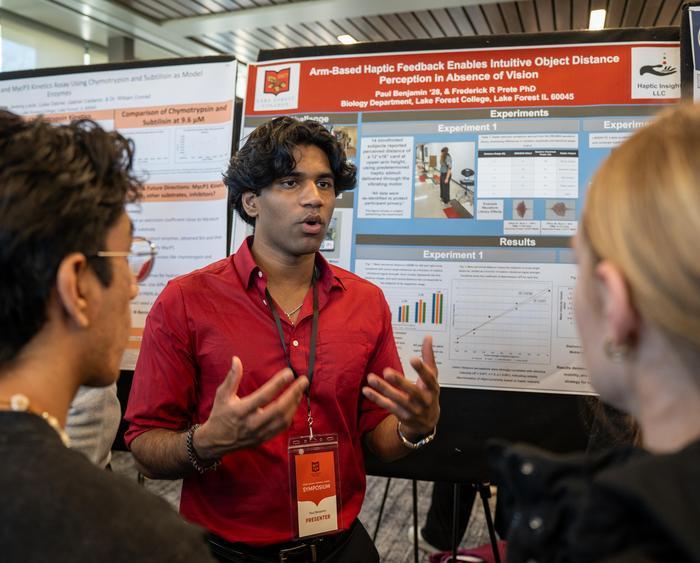
How does research experience set you apart?
Gaining high-level research experience early in an undergraduate career is uncommon at most schools, but at Lake Forest College, it’s our way of operating. We prioritize research early on by allowing students to participate in the Richter Scholar Program the summer after their freshman year.
Annually, 30 to 50 first-year Foresters are selected to participate in the Richter Summer Scholar Program.
Nearly half of Richter students who go on to grad school complete doctoral level-degrees.
Additionally, Richter students are:
3.5
Times
more likely
to be inducted into Phi Beta Kappa honors society
3.6
Times
more likely
to go on to grad school
3
Times
more likely
to earn a coveted Senior Award
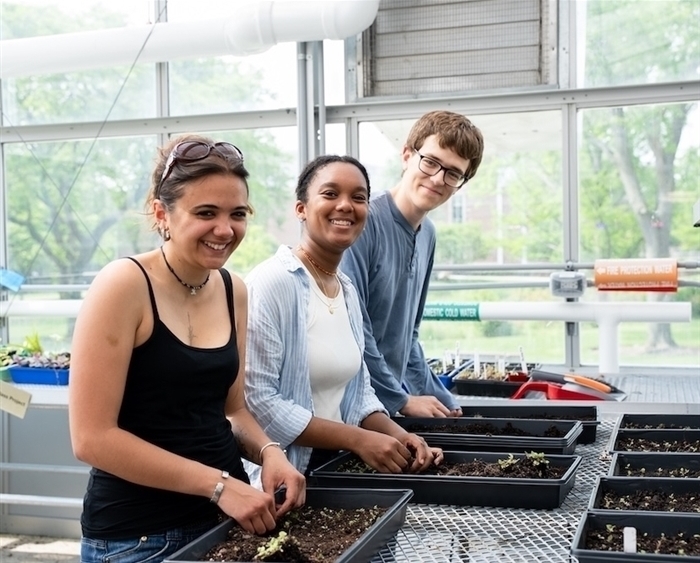
Richter project: How do native plant lawns impact local ecologies?
Students in Lake Forest College's Richter Summer Scholar program are investigating the environmental benefits of lawns that feature native plants. As opposed to classic turf grass lawns, native lawns provide more resources for insects and pollinators, along with a variety of other benefits.
Why is research as an undergraduate student important?
Experiential learning, including research, is a key part of student development. It allows students to try out new things, gain a sense of what they enjoy, and put skills they learn in the classroom into practice. Experiential learning also provides a crucial real-world perspective to learning that helps students understand how what they learn in college impacts their career trajectory after graduation.
Research experience prepares students for future high-level graduate research and engaging careers beyond the College.
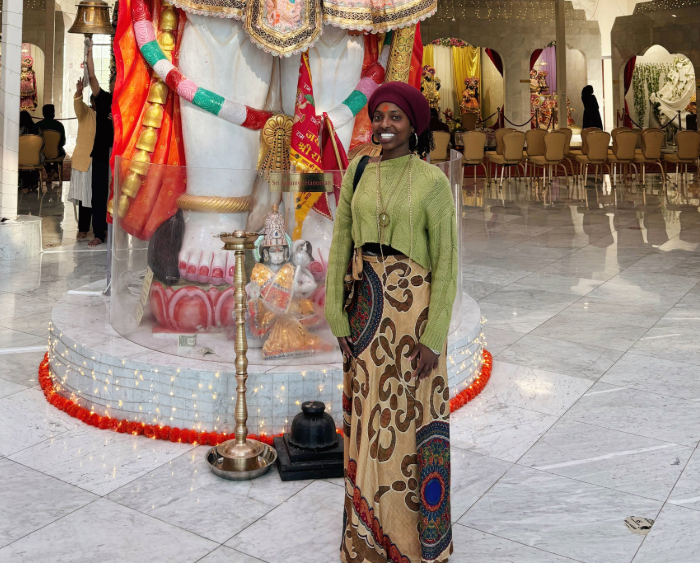
Tracy Wamarema ’28 films documentary through Richter Scholar Program
As an international first-year student from Kenya, participating in the Richter Scholar Program was a cocktail of “firsts”: my first summer in America, my first interaction with Hindu culture, and my first real taste of independent fieldwork.
Richter Scholar News
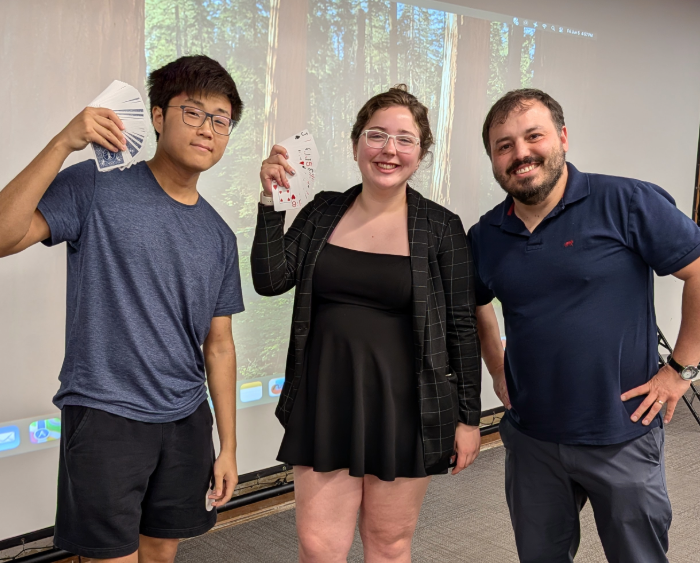
June 23, 2026
Trevor Madden '29 learns the math behind magic
June 03, 2025
Karen Kirk publishes paper with eight student co-authors
- 8:30 a.m.: Coffee and set up
- 9-10:20 a.m.: Session 1
- 10:30-11:50 a.m.: Session 2
- Noon-1 p.m.: Lunch
- 1:10-2:30 p.m.: Session 3
- 2:40-4 p.m.: Session 4
Full schedule below
Session 1
9–10:20 a.m.
Arts Machina Vitae: Where Stories Become Systems by Destiny Roque Avila
Mentor: Tracy Taylor
"Where the East Shakes Hands with the West": The Shadow War in Cairo, 1939-1945 by Charlotte Beatrice Radler
Mentor: Danielle Cohen
Digital Innovation in Language Education and Development in Multilingual Africa by Raquel Culajay Palma and Ayisha Kamwendo
Mentor: Desmond Odugu
Session 2
10:30–11:50 a.m.
Development of Organic Chemistry Reactions in Water by Ava Mae Thomas and Noor Muhammad
Mentor: Erica Schultz
Finding the function of a tuberculosis drug target by Izabella Angel Zamora and Nishela Abeysiriwardena
Mentor: Will Conrad
The molecular and cellular mechanisms of organismal phenotypes by Sam N Kasner and Mariana Mejia
Mentor: Rebecca Delventhal
Session 3
1:10–2:30 p.m.
How do Four Novel Alpha-Synuclein Mutations Contribute to Parkinson’s Disease Toxicity? By Mario Guzman, Shanida Orus, Ali Shadman, and Sarah Sitoula
Mentor: Shubhik DebBurman
Molecular Biology of the Two Telomerase Components by Natalia Brenda Garcia San Miguel and Sophia Berdnichenko
Mentor: Karen Kirk
Session 4
2:40–4 p.m.
Building a Dataset for Assessing LLM Response Styles by Natalie Eva Meler
Mentor: Sara Jamshidi
Ecology Under Autonomy: Everyday Aesthetics Infrastructure and Politics in Zapatista and Rojava Co by Kenvah Cashay McCampbell and Irene Arbelo Garcia
Mentor: Jyothis James
RATionality: social decision making in a rodent model of the dictator game by Anthony Polonski and Taim Yaghi
Mentor: Hannah Carlson
The early research experience students obtain through the Richter Scholars Program sets students on an upward trajectory that leads to academic honors and graduate school completion at much higher rates.
Richter Scholar Program Contact Information
Richter Program Committee
Enrique Treviño, Chair (Math, Computer Science)
trevino@lakeforest.edu
Courtney Joseph, 2026 Summer Director (History and African American Studies)
cpjoseph@lakeforest.edu
Arthur Bousquet, (Math, Computer Science)
bousquet@lakeforest.edu
Tilahun Emiru (Economics)
temiru@lakeforest.edu
Paul Henne (Philosophy)
phenne@lakeforest.edu
Matt Kelley (Associate Dean of the Faculty)
kelley@lakeforest.edu
Tessa Sermet (French)
sermet@lakeforest.edu
Elayne Vollman (Psychology)
evollman@lakeforest.edu
2026 Summer Director
Courtney Joseph (History and African American Studies)
cpjoseph@lakeforest.edu