
September 10, 2026
Linda Blaser
Lifetime of teaching inspires a lasting gift
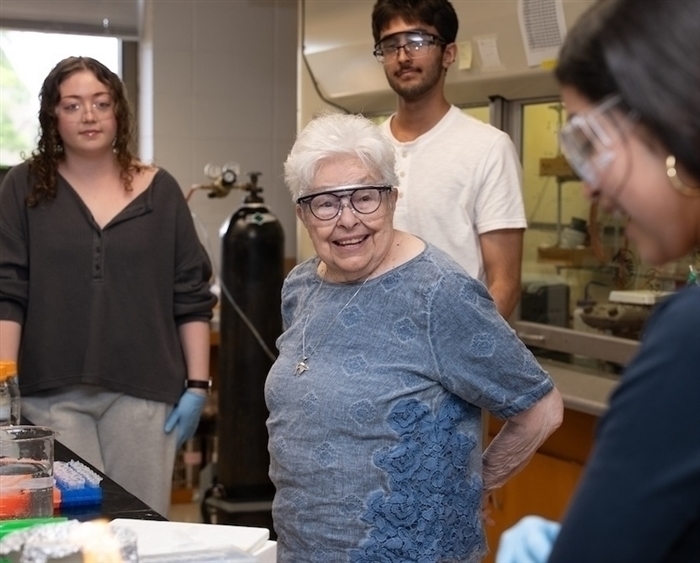 Dr. Yvonne Martin visits with lab students (from left) Ava Thomas ’29, Noor Mohammed ’29, and Karem Alejandra Hernandez Guerrero ’27.
The wife of longtime Lake Forest College Professor William Martin makes a $7 million gift to the College’s science programs.
Chemistry Professor William Martin was a legend at Lake Forest College, teaching thousands of students and mentoring generations of faculty over five decades before his death in 2024. To ensure that his legacy continues to shape the lives of students and early-career professors, his wife, Dr. Yvonne Martin—a world-renowned chemist herself—has made a transformational $7 million gift to the College’s Department of Chemistry.
This gift will fund the creation of the William B. Martin Endowed Professorship in Chemistry, the William B. Martin Equipment Fund, and the William B. and Yvonne C. Martin Student Research Fund. It also will continue to support the Yvonne C. and William B. Martin Scholarship Endowment.
“Bill and I benefitted greatly from our education at a small liberal arts college whose fees our parents could not afford. We feel strongly that such an opportunity should be made to as many young students as possible. It will enhance, if not challenge, their life experiences,” Yvonne Martin said.

Dr. Yvonne Martin and Professor William Martin | Courtesy of Carleton College
Professor Martin joined the College in 1961 and, over the course of his career, taught more than 2,000 students in organic chemistry and hundreds more in biochemistry. He also directed more than 65 senior theses, leaving a lasting impact on generations of Lake Forest College students.
Today, Yvonne Martin’s gift ensures that the same spirit of mentorship, discovery, and hands-on learning will continue for generations of Lake Forest College students.
“Professor Martin understood that some of the most transformative learning happens when students are given the opportunity to work closely with a faculty mentor, ask questions, conduct research, and discover what they are capable of,” Dr. Tara Natarajan, Krebs Provost, Vice President for Academic Affairs, and Dean of the Faculty, said. “Yvonne’s extraordinary generosity honors that legacy while ensuring that Lake Forest students will continue to have those same opportunities to learn by doing, pursue their curiosity, and build the confidence to become scientists and scholars in their own right.”
Yvonne Martin matched her husband’s passion for chemistry with a groundbreaking career of her own, spending 40 years at Abbott and AbbVie and helping pioneer computational chemistry for drug discovery. A founder of the International Quantitative Structure Activity Relationship & Modeling Society (QSAR), she has earned international recognition for her research, publications, and leadership in the field.

Professor Martin works with a student in 1986. | Photo by Bradford F. Herzog, Courtesy of Lake Forest College, Archives and Special Collections, William Martin Photograph Collection
Long-term impact
Many of Professor Martin’s students went on to very successful careers in academia and the sciences.
Back in the 1980s, Dr. Bruce Kaplan ’85, MD, worked closely with Professor Martin. A long-time board-certified opthalmologist, Kaplan credits his years under Professor Martin’s tutelage with his career success.
“Dr. William Martin was one of the most influential people in my life,” Kaplan said. “He taught me how to think, analyze, prepare and execute to a level that helped me throughout my entire medical career as an ophthalmologist. The many hours spent in his classroom and after hours asking questions in his office also revealed what a kind, compassionate, and generous man he was. It was truly an honor and a privilege to have been educated by Dr. Martin.”
Like his father, board-certified opthalmologist Dr. Tyler Kaplan ’16 considers Dr. Martin “one of the most influential teachers in my education,” he said.
“Dr. Martin’s organic chemistry and biochemistry courses challenged me to think critically, solve complex problems, and persevere through rigorous academic demands,” Tyler Kaplan said. “The discipline, analytical thinking, and resilience I developed in his classroom have served me throughout my career as a physician. His example inspired me to pursue a career in academic medicine, where I hope to have a similar influence on the next generation of physicians through teaching, mentorship, research and patient care.”
“Dr. Martin demonstrated the profound impact a dedicated educator can have on students’ lives.” — Dr. Tyler Kaplan ’16
While today’s physics major Peter Cirbo ’27 never had the opportunity to meet Professor Martin, the 2025–26 recipient of the Yvonne C. and William B. Martin Scholarship Endowment has felt his impact. Cirbo is grateful for his Martin scholarship and is dedicated to working hard so that he can “get the most out of my education and experience at Lake Forest College,” he said.

In his time at Lake Forest, the men’s soccer team captain has worked in Professor Mueggenberg’s lab, where “I was able to design my own lab experiment using Schlieren optics, code for an uncertainty propagation software using MATLAB code, and write code that evaluates elliptical integrals of the first and second kind. It was very cool to understand difficult concepts and also help make some updates to lab procedures and even create my own.” He calls this hands-on opportunity an “amazing experience” in his undergraduate education.
Cirbo is on track to attend Washington University after graduation as part of a dual-degree engineering program. In the end, Cirbo will earn a bachelor's degree in physics at Lake Forest and a master's in chemical engineering at WashU.
“My Lake Forest College professors have helped me deeply in giving me the tools I need to succeed and guide me in the correct direction,” Cirbo said.
Yvonne Martin knows firsthand the importance of receiving this type of financial aid and what a difference it can make in a student’s life. When she was about to start college herself in the fall of 1954, Yvonne’s parents realized they were $50 short of what they needed to cover her costs. She notified her school, Carleton College, which set up a 100-hour work-study position that enabled Yvonne to make up the difference.
“Financial aid allowed me to attend Carleton,” she said simply of the gift that launched her future. Yvonne eventually earned a PhD in chemistry that led to her successful career in drug research at Abbott and AbbVie.

Dr. Yvonne Martin meets with students in Associate Professor William Conrad’s research lab.
“Yvonne Martin’s generosity is a powerful investment in the future of Lake Forest College,” President Mike Sosulski said. “Her gift honors Bill’s remarkable legacy while giving today’s students—and generations of students to come—the resources, mentorship, and hands-on experiences that can change the trajectory of their lives. It is a beautiful example of how a lifetime of learning and discovery can create opportunities that endure far beyond one generation.”
The many sides of Professor Martin
“One of Bill’s defining characteristics was his broad intellectual curiosity,” Yvonne said.
Although chemistry was his primary passion—“into which he delved broadly and deeply, not just the concepts and theories but also the people involved,” Yvonne explained—his interests extended well beyond the sciences. He was widely read in wartime history, railroads, and other technological topics, and he was an opera and theater buff who even enjoyed a little ballet.
“He was what was popularly called ‘a well-rounded man,’” she said.
His generosity matched his curiosity. “He carefully mentored not only his students, but students from other disciplines who crossed his path, the departmental assistants, and young faculty from many departments,” Yvonne said.
Research sparks discovery
Associate Professor and Chair of Chemistry Nilam Shah is one of several professors mentoring students who are doing research this summer and throughout the school year, thanks to the Martin Student Research Fund.
“The Martin Student Research Gift offers a unique kind of support,” Shah said. “While grant-funded research usually focuses on exploring a specific project, the Martin Gift gives students the freedom to explore a variety of research areas and discover new interests. This flexibility allows students to develop as researchers, find projects that inspire them and see where it takes them.”
A student-led Alzheimer’s research project is one such example. After teaching her lab students one research technique for art conservation, Shah opened the door to new possibilities.
“I gave them the basics and told them, ‘If there’s anything else you’re interested in, let me know.’ And so last year they expressed interest in Alzheimer’s, so we started looking into that,” Shah said. “We really want to empower our students to figure out what they want to do, what they want to study.”
Elsa Carlson ’28, for one, appreciates the freedom to explore. A chemistry and art history double major, Carlson originally came to the College interested in art conservation.

Elsa Carlson ’28 (center) shares a laugh with Elia Kiameh ’28 and Dr. Yvonne Martin.
“Now I know that there are so many different avenues you can take with research,” Carlson said. “It’s cool to see how you can take one sort of research and go into so many different directions.”
This new funding from Yvonne and other summer research supporters ensures that students get paid a living wage during their summer on campus so that they can concentrate fully on their work in the lab.
Yvonne Martin said she is “happy if I can foster interest in such a career in young students. The endowed funds to support student research and chemical instrumentation provide a student with the chance to experience research early in their development.”

Department of Chemistry faculty, staff, and summer research students meet with Dr. Martin. Twelve of these students were funded by the Martin Student Research Gift.
Equipment fund fuels hands-on learning
Professor Martin was one of the first College science professors to introduce hands-on chemistry. The classroom and textbook were important, but working in the lab to generate ideas and allow students to solve problems independently was integral to their scientific development, he felt.
Ensuring that students have access to the same equipment used in industry—and learn to use it as part of their regular laboratory experience—remains central to the College’s chemistry program. The William B. Martin Equipment Fund will help ensure that Lake Forest College students continue to receive that hands-on preparation.
Yvonne recalled a time when a Lake Forest chemistry graduate applied for a job in California. After the interview, the company representative called Professor Martin and told him the graduate must have lied. “She can’t possibly know how to use this equipment,” Yvonne recalled her husband telling her later. “Bill told him, ‘She didn’t lie. They learn how to use this in our lab.’ She was hired.”
Today, students in the chemistry research labs still use equipment and supplies from Professor Martin, including research grade instrumentation like a High-Performance Liquid Chromatography system that gives students an advantage in the job market and even some of his chemicals. Thanks to the new Martin Equipment Fund, that equipment cache will grow to help even more students conduct science research—and the new professors, too.

Associate Professor of Chemistry Erica Schultz (left), Ava Thomas ’29, Haylee Christopher ’27, Dr. Yvonne Martin, and Rachel Weiser ’28.
“I inherited Professor Martin’s lab space when I first started,” Associate Professor of Chemistry Erica Schultz said. “He would often stop by to ask how I was doing. If I ever mentioned that I was needing a piece of equipment, he would quietly nod and return to his office, and often the next day I would return to find that equipment sitting on the lab bench waiting for me.”
That helpfulness and generosity has endured.
“Bill and Yvonne’s focus on research grade instrumentation has greatly benefitted my career and those of our students,” Schultz said. “Due to their generosity, the chemistry department has several pieces of instrumentation that are not found at similar institutions. This allows my research to progress rapidly, and students from my research lab to be very competitive on the job market.”
Associate Professor Shah speaks highly of Professor Martin’s passion for chemistry and commitment to mentoring both faculty and students.
“He transformed numerous lives through his dedication to mentorship and hands-on learning,” Shah said. “The Martin Student Research Gift and Equipment Fund will allow the chemistry department to continue his legacy by providing future generations of students the opportunity to gain hands-on research experience using professional-grade instrumentation.”
Dawn Wiser named first ‘Martin Professor’
 Dawn Wiser is the first William B. Martin Associate Professor of Chemistry. A member of the faculty since 1998, Wiser earned her PhD in chemistry from Colorado State University. She was a postdoctoral research fellow at the Exxon Chemical Company at its Baytown Polymers Center. She earned her bachelor’s at Muskingum University.
“I established this professorship to honor Bill for the many years that he devoted to the students, the chemistry department, and his faculty colleagues,” Yvonne Martin said.
Wiser is honored to be named the William B Martin Associate Professor of Chemistry and reflects on the effect Professor Martin had on her teaching career.
“I’m the teacher I am today, in many ways, because of his mentorship and his example,” she said.
Watching Professor Martin interact with his students, Wiser “realized early on the importance of framing decisions to be student-centered and focusing on what is best for their development,” she said.
“The professorship ensures that the chemistry department will have an inspiring professor that cares deeply about the intellectual development of their students.” — Dr. Yvonne Martin
When Wiser asked Professor Martin for advice, he invariably responded: “What is best for the student?”
Wiser has long operated with that question in mind. “It’s important to establish high standards and then to work closely with each student to help them achieve those standards,” she said.