

May 07, 2026
Linda Blaser
Students address environmental governance in Public Policy Analysis Challenge
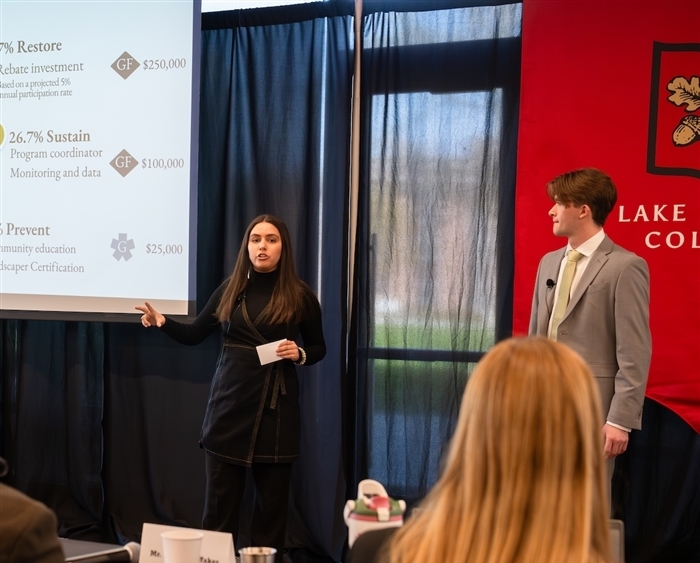
From ravine restoration to unified water management to old-growth logging, Lake Forest College students tackled complex issues posed by governing the environment during the 2025–2026 Public Policy Analysis Challenge.
This year’s competition theme, Governing the Environment invited students to apply an interdisciplinary approach to develop rigorous, evidence-based policy proposals directed at the local, state, national, or international level of governance, which were evaluated by a team of external experts.
19 teams competed
The 19 teams that participated in the preliminary round explored a wide range of important topics from environmental challenges posed by AI data centers to efforts to mitigate urban air pollution in Chicago communities, and initiatives to promote the creation of urban greenhouses.
The three final-round teams were evaluated based on an executive summary and white paper submitted in advance to the judges, as well as a live presentation. Teams had 10 minutes to present, followed by a 10-minute Q&A session with the judges. The teams competed on April 26, 2026 for cash prizes from a pool of $10,000.
“The Public Policy Analysis Challenge epitomizes the four pillars of Lake Forest College’s public policy program: promoting interdisciplinary collaboration, cultivating global citizens, providing supportive mentorship, and creating experiential learning opportunities that enable students to apply their knowledge from inside and outside the classroom to a critical public policy problem of their choice,” said Danielle Cohen, director of the public policy program and teaching professor of politics and history.
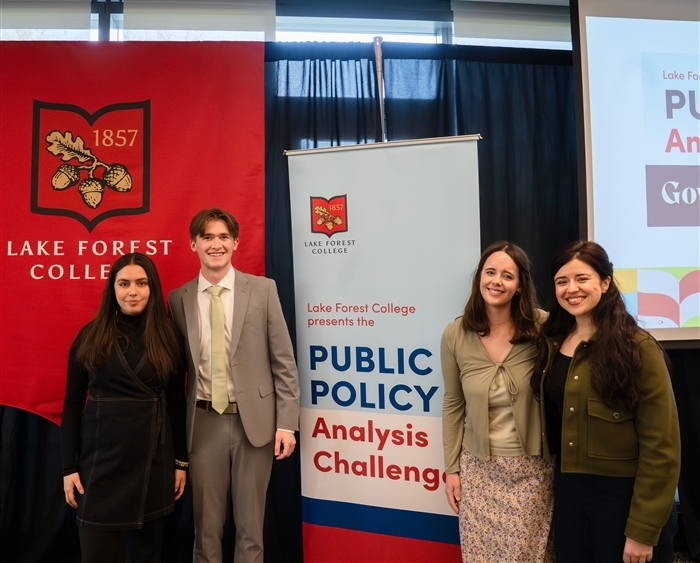
First Place
“Restoring Ravines: A Lake Forest Stewardship and Resilience Project”
Valeria G. Corzo ’27
Liam Thumser ’27
Laine Sperry ’27
Mentor: Assistant Professor of Politics and International Relations Alejandra López Villegas
“Solving real problems requires real connections. By meeting with the City, neighbors, and local organizations, we realized that an effective public policy must prevent damage, restore the slopes, and sustain our local ecosystem.”
— Valeria G. Corzo ’27
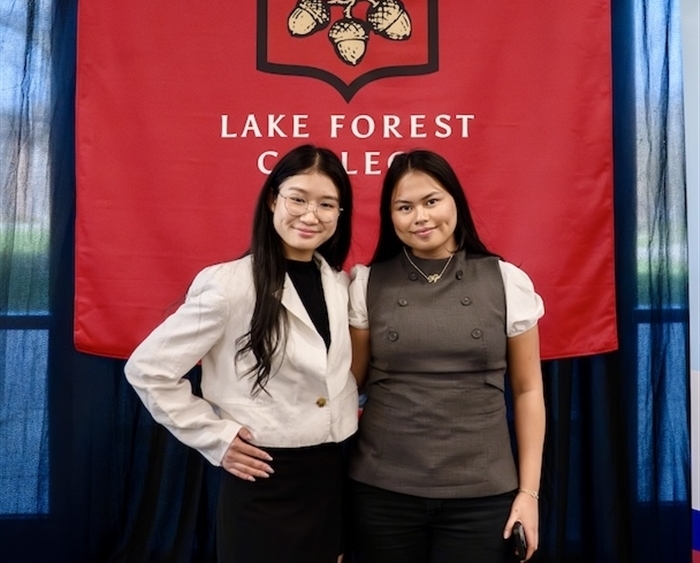
Second Place
“Unified Water Management in Siargao Island, Philippines”
Tingky Pongviengthong ’29
Kyle Nicola Lee ’26
Mentor: Visiting Assistant Professor of Biology and Environmental Studies Joshua Hedge
“What mattered was that a problem affecting real people in a real place was taken seriously in a room where policy is shaped.”
— Kyle Nicola Lee ’26
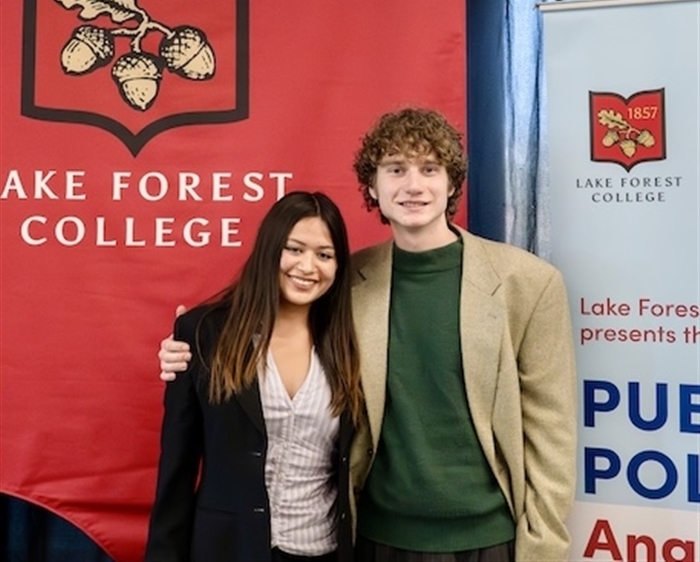
Third Place
“Review to Action 2.0: Public Policy Targeting Old-Growth Logging on Vancouver Island”
Mariana Mejia ’29
Owen Dornan ’29
Mentor: Professor of English Carla Arnell
“While I wasn't part of the public policy incubator class, I still wanted to participate in the challenge. I was able to turn my love for the old growth forests of Vancouver Island into a tangible policy that could help protect such a valuable ecosystem.”
— Owen Dornan ’29
Meet the judges
The judges for the final round of competition brought vast experience to the contest:
- Buddy Huffaker, Executive Director, The Aldo Leopold Foundation
- The Honorable Mark Kirk, former United States Senator and United States Representative
- Richard (Max) Melstrom, PhD, Endowed Associate Professor, School of Environmental Sustainability, Loyola University Chicago
- Amanda Urban, JD, Associate Regional Counsel, Environmental Protection Agency