

March 09, 2026
Schneiderman expands HUMAN initiative’s national reach as leadership transitions to new co–principal investigators
As Lake Forest College’s Mellon-funded HUMAN initiative enters its next phase, its work at the intersection of humanistic inquiry and artificial intelligence continues to resonate far beyond campus, while new leadership prepares to guide the project forward.
Supported by a $1.2 million grant from the Mellon Foundation, the multi-year HUMAN project supports interdisciplinary faculty research, curricular innovation, and institutional partnerships exploring emerging technologies through the humanities. Under the leadership of Executive Director of the Krebs Center for the Humanities Davis Schneiderman, the initiative has helped position the College as a national voice in conversations about AI, ethics, and liberal arts education.
Taking the Conversation on the Road
Over the past year, Dr. Schneiderman has brought Lake Forest’s distinctive, human-centered approach to AI to campuses and communities across the country.
In Fall 2025, he delivered invited lectures and workshops at Monmouth College, School of the Art Institute of Chicago (SAIC), Cornell College, and Knox College, as well as with District 112 educators. In early 2026, he spoke with Palisades Charter High School in Los Angeles and Rhodes College in Memphis, with additional spring engagements scheduled at Rosalind Franklin University of Medicine and Science, Bucknell University, and the Racquet Club of Chicago, among others.
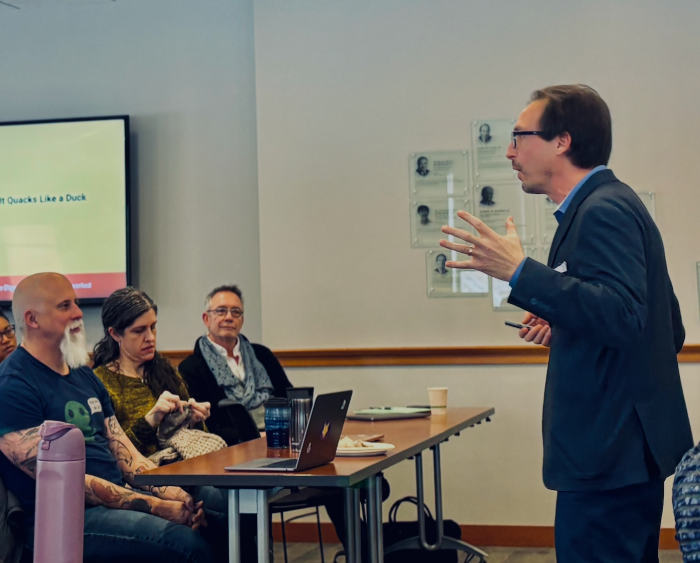
 Schneiderman at SAIC
His talks—including “Creativity, Entrepreneurship and Innovation in the Age of Artificial Intelligence” and “Beyond the Hype: What AI Really/Definitely/Maybe Means for the Liberal Arts”—emphasize a core HUMAN principle: that entrepreneurship, creativity, and ethical reflection are inseparable in an AI-powered world.
“Entrepreneurship is fundamentally about creativity,” Schneiderman has noted in his recent lectures at Rhodes. “And creativity is being challenged—and reshaped—by the widespread adoption of AI.” Across institutions, he has engaged faculty, administrators, and students in candid conversations about AI literacy, classroom experimentation, accessibility, and the enduring value of human judgment.

At Rhodes, his visit brought together an unusually broad coalition of sponsors—from politics to ancient Mediterranean studies to business to religious studies and many more—underscoring the interdisciplinary urgency of the topic. At SAIC, he spoke with Student Affairs leaders about centering care, connection, and ethics in technology-enhanced initiatives for student success. He also facilitated a third time a section of the Center for AI Safety’s popular AI Safety, Ethics, and Society course.
International Partnerships and Public Scholarship
The HUMAN initiative’s global footprint continues to expand through its growing partnership with the University of Bergen’s Center for Digital Narrative (CDN) in Norway. As part of that collaboration, Schneiderman recently recorded a podcast episode with colleagues at the Center, exploring digital narrative, artificial intelligence, and the future of storytelling, further bringing Lake Forest’s work to an international audience.
In addition, the CDN collaborated with Lake Forest on the recent More than Meets AI exhibition at the College’s art galleries, co-curated by CDN and Associate Professor of Art David Sanchez-Burr.
These exchanges build on a partnership that has already supported faculty research, student engagement, and transatlantic dialogue on technology and the humanities.
Leadership for the Next Phase
As Schneiderman will soon assume the presidency of Ringling College of Art and Design, HUMAN’s leadership will shift to two longtime collaborators.
Associate Professor of Communication Rachel Whidden and Professor of Religion Ben Zeller will serve as Co–Principal Investigators of the HUMAN grant. From the outset of this project, the initiative has been deeply collaborative, and both Professor Whidden and Professor Zeller have served as co-project directors, helping to shape its intellectual vision, faculty programming, and external partnerships.
“The HUMAN initiative has already had a major impact on campus. We’ve supported innovative research and teaching through the HUMAN Fellows program, which has fostered opportunities for undergraduate research and cutting edge engagement with new technologies. We’ve partnered on and off campus to bring in speakers, workshops, and other events. And most importantly, we’ve helped students and colleagues think critically and creativity about the disruptive power of AI technology,” Zeller shared. “Going forward, we look forward to the grant’s culminating year, which includes bringing together our fellows and partners for a forward-looking.”
Together, Whidden and Zeller have advanced ambitious faculty research projects, strengthened national and international collaborations, including the expanding partnership in Bergen, and supported curricular innovation across disciplines. The College’s new minor in artificial intelligence emerged organically from the momentum of the HUMAN grant and its faculty leadership, in strong partnership with Assistant Professor Computer Science and Mathematics and co-chair of the program Sara Jamshidi.
Both Zeller and Whidden bring distinguished records as scholar-teachers and experienced program leaders. Their appointment ensures continuity while opening new possibilities for growth, experimentation, and expanded impact across the College.
A Model for the Liberal Arts
From national lectures and community engagement to international research partnerships and curricular innovation, the HUMAN initiative continues to model how a liberal arts college can lead in an era defined by rapid technological change.
Grounded in ethics, creativity, and interdisciplinary collaboration, Lake Forest’s approach affirms a central conviction: that the future of AI will be shaped not only by engineers but by humanists—and by institutions willing to ask the most difficult and necessary questions.
