April 16, 2013
Biology students discover possible evolutionary link between yeast, humans
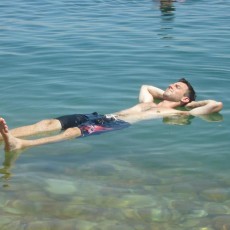 Paulius Kuprys ’12 floats in the Dead Sea during his summer trip to Israel. He spent a month there to work with a gene e...
Paulius Kuprys ’12 was the lead student researcher for the project. He traveled to Israel for a month last summer to work with gene expert Dr. Yehuda Tzfati, who validated the research. Kuprys also had time to explore and take a swim in the Dead Sea.
Research examining telomeres in filamentous fungi that began more than four years ago recently wrapped up with publication in PLOS ONE, a journal featuring reports on original research within the disciplines of science and medicine. Even more exciting for the student research team, though, is that their findings uncovered information that begs for continued study, particularly in the community of evolutionary science.
In the article, “Identification of Telomerase RNAs from Filamentous Fungi Reveals Conservation with Vertebrates and Yeasts,” lead student researcher Paulius Kuprys ’12 as well as Shaun Davis ’09, Tyler Hauer ’13, and Max Meltser ’09 describe a new gene they discovered in several types of fungi, making these fungi a possible evolutionary link between yeast and humans.
“People are surprised at the DNA sequence that he found because it’s a little like vertebrates and a little like yeast,” said Professor of Biology Karen Kirk, the faculty advisor of the research that was funded by the National Science Foundation.
Meltser started the research, and Kuprys took over the spring of his junior year. He continued working past graduation to get the paper published.
“Initially it seemed like the project wasn’t going to be fruitful in any way. Another lab was doing similar research and was expected to publish earlier,” Kuprys said. “But I was able to find some other sequences to make their research significantly different from our work. It took a long time.”
As part of the experience, Kuprys traveled to Israel for a month during the summer to validate his findings with specialist Dr. Yehuda Tzfati, who is also listed as an author on the paper. Also while there, Kuprys met with other scientists, presented his research, took a climb in the mountains, and toured Jerusalem. The trip was paid for by Kirk’s grant.
For Kuprys, the project came at a time in his education when he was trying to figure out what area of biology he wanted to pursue. Now, he is studying for the MCAT so he can earn an MD/PhD, which would give him the ability to bridge the medical world with the research world.
Kirk often tells her student researchers, “We all stand on the shoulders of the scientists before us.” This reminder became especially relevant for this research project. Not only did students pick up where others left off, but they have opened the door for others to follow.
News Contact
Kellie Doyledoyle@lakeforest.edu
847-735-6177